1.0 Introduction
Deregulation of the telecommunication services industry, and the increased competition that results, create opportunities for Excel Switching Corporation. In the de-regulated market, carriers first compete on price, and then based upon the rapid introduction of new telecommunications services. To respond to these new competitive pressures, carriers must implement new approaches and lower-cost network infrastructures. Incumbent local exchange carriers (ILECs) and inter-exchange carriers (IXCs) are looking for multi-application enhanced service platforms with the flexibility to easily integrate into their existing routing networks. Emerging carriers, such as competitive local exchange carriers (CLECs), new IXCs, wireless local loop (WLL) or personal communication services (PCS) providers, who do not have infrastructure installed today, want to build one network that cost-effectively grows as they grow, with the flexibility to provide both basic and enhanced services from any switching platform.
Excel provides a unique breed of open and programmable switching technology that helps carriers succeed in this new environment. By combining Excel's distributed switching architecture, the Expandable Switching System (EXStm), with its programmable EXS Software environment, based upon Programmable Protocol Language (PPLtm) technology, network providers are able to lower their costs and implement many revenue-generating services faster than they can with older, traditional, single-service switches. In providing a very scalable switching platform with extreme flexibility, Excel has developed a track record for providing carriers with enhanced service platforms that can be easily integrated into any service or network environment. Carriers in almost 60 countries rely on Excel switching platforms, regardless of subscriber population, variations in service requirements and call models, or the need for unique network protocols. These advantages, along with highly reliable products and responsive customer support, have helped Excel become a leader in open switching platforms.
With Open Network Expansion Architecture, or ONE Architecturetm, Excel significantly extends its industry-leading technology to new levels of programmability, openness, and scalability. These capabilities position Excel to establish the new standard for network-based solutions. Carriers worldwide can rely on ONE Architecture to provide them with a network infrastructure that offers them the growth and flexibility they need to satisfy their new market requirements. ONE Architecture accomplishes this by enabling them to easily establish and expand their networks in terms of subscriber growth, services and geography.
Return to contents....
| Features | Advantages | Benefits |
|---|
| Seamless Integration | | |
| Add Unique Services to Basic Services | Become Responsive to Subscriber Needs |
| Add Third-Party Resources, Applications, and Services | Increase Service Revenue |
- Network Integration/Management
| Integrate Subscriber, Billing, and Network Management Functions | Reduce Network Operations Costs |
| Single Common Architecture | | |
- Same Programming Approach, Call Models, and Programming Tools
| Grow without Redeveloping;
Eliminate Technology Costs;
Increased Reliability | Reduce Long Term Costs;
Increase Revenues |
- Extended to Third-Party Hardware, Software, and Standards
| Easy to Use
Best Technology Available | Faster Time-to-Market
Integrated Services decreases mgmt costs |
| Open Programmability | | |
| Keep Pace with Technological Advances | Reduce Long Term Costs;
Expand Geographically |
| Timely Response to Market Demand | Attract and Retain Subscribers |
| Drive New Services and Subscriber Usage | Increase Revenues |
| Distributed Architecture | | |
| Build one Solution to meet any Demographic Need | Lower Initial Investment;
Cost-Effective Growth |
| Better Performance;
Supports 1.2 Million BHCC | Lower Life-cycle Costs |
- Optimized for Specific Service Mix
| Better Resource Utilization;
Better Performance | More Profitable Services |
3.0 Programmable Switching Basics
Prior to the start of telecommunications market deregulation in 1980's, telephony services were basic: dial tone, local and long distance switching, and manual operator services. Traditional switching platforms were designed to efficiently handle a high volume of this standard traffic in a single carrier network. The software program that implemented the switching model was simple enough to be loaded onto, and directly executed by, a proprietary central office switch. Thus, traditional switches were designed to be single-purpose, and networks based upon them used a hierarchical approach to separate various levels of the network routing structure.
Deregulation and liberalization have irreversibly changed this traditional model. Today, the number of network providers has multiplied many times, the variety and complexity of services has grown immensely, and new networks supporting wireless communications are competing with traditional landline infrastructures. The traditional switch supplier has responded to these new telecom market requirements, not by re-designing their basic "stored-program" switching architecture, but by incrementally adding to and modifying their switch hardware and software. Today the complexity and size of the traditional switch is so great that it has become difficult for these products to keep pace with competitive requirements in the telecom services market. Due to the closed and proprietary nature of traditional switches, faster or more creative approaches to service implementation from third parties are impossible.

Figure 3.0-1. This chart depicts the parallels between the computer industry and the telecommunications industry, and illustrates the trend toward open, programmable, distributed systems.
Network providers tried to solve this problem by conceiving the Intelligent Network, which puts an equally complex computer software and data communications network on top of the voice network. While this has helped carriers implement some new services, the complexity of the IN and the traditional switching network it is designed to control still restricts carrier speed, flexibility, and creativity.
Excel has designed its programmable switching platforms to overcome the restrictions of competitive approaches, enabling carriers to quickly and flexibly create competitive services. Excel's approach opens-up the switching platform, allowing the system to be externally programmed and/or controlled by flexible service logic residing in standard computers or down-loaded to the switching platform. Excel uses a state-of-the art distributed switch design, and powerful open programming tools, to allow application developers and carriers to implement any service, with the feature and protocol flexibility needed to quickly and easily deploy them within new or existing network environments.
Return to contents....
4.1 Distributed Architecture
The EXSTM hardware system is designed so that processing and switching can be effectively spread among a number of resources optimized for a particular job. One or more (possibly fault-tolerant) host computers execute higher-level call management and service logic. Since Excel's host programming interface is open, carriers select specific computing environments based upon optimum fit with service requirements. Multiple services (computer applications) can be executed on one or multiple host computers in order to achieve the best service mix, performance, and reliability. EXS software configures and manages messages between the switch and computing elements, based upon a variety of service-specific or call-specific factors determined by the application developer or service provider.
The EXS switching fabric is also distributed. At the highest-level, one or more EXS switching shelves (1,024 to 4,096 ports per shelf) may be configured. Each contains a Switch Matrix/Central Processing Unit (CPU), as well as a variety of intelligent line cards, common channel signaling (CCS) engines, digital signal processing (DSP) resource cards and other services – each with its own dedicated processing and switching capabilities. Each of these components is designed for maximum cost-effectiveness and performance based on its specific function.
EXS switching shelves are connected to a switching backbone called EXNET. They connect to the fiber backbone using EXNET Connect cards employed on each switching shelf. The EXNET card, with its own Matrix/CPU, focuses on switching calls that originated in one switching shelf through the EXS switching fabric to other resources in the EXS system. Each EXNET board-set executes the EXS distributed software. This software manages inter-module messages containing information on active calls and hardware status, allowing one to be mapped to the other. As capacity or other specialized resources are added, the EXS can readily utilize and incorporate them into the EXS system.
EXNET can also integrate third-party media resource hardware and software into the switching fabric, through the use of the EXNET Connect card, which is installed in a PC chassis and connects the EXNET backbone to industry-standard media resources (such as ECTF H.100, MVIP, and SCBus). EXNET Connect contains a 2,048 port Matrix/CPU processor which manages all EXS messages and allows the media resources within the connected PC to be tightly integrated into the EXS switching fabric. By utilizing the additional 2,048 ports of switch capacity on EXNET Connect, back-end trunks that would have been required to connect to the media resource modules, are made available for connection to the public network – essentially doubling the capacity of the typical EXS module to 4,096 ports.
Excel's unique "selective space switching" concept organizes the systems' distributed units into an efficient hierarchical non-blocking switching fabric. Resources can be added to the EXS system without reducing basic switch matrix capacity. Selective space switching increases the capacity, utilization, performance and cost-effectiveness of Excel switches.
Return to contents....
4.3 Programmable Protocol Language (PPL) Technology
Excel's unique and patented PPLTM technology establishes the underlying programmability designed throughout the EXS software. Excel implements modular software components within PPL's powerful finite state engine environment. Application developers use high-level graphical development tools to build scripts from programmable components, down-loading them to the EXS for real-time execution.
PPL was originally conceived to provide a fast, cost-effective method to help third-party developers implement hundreds of E1/R2 signaling variants required for global expansion. Based upon its early success, PPL technology has now been extended to all signaling types (T1, ISDN, SS7) and DSP resources, as well as to higher-level call management, supplementary service logic, and management functions.
Specific scripts, describing system functions, are loaded into various hardware modules contained in the EXS distributed architecture for processing. Protocols execute in their respective protocol/packet engines, call control and service logic executes in the EXS Matrix/CPU, etc. This modular and distributed processing approach allows specific scripts to be easily changed, and maximizes system performance by allowing specialized hardware to be allocated to a particular function.
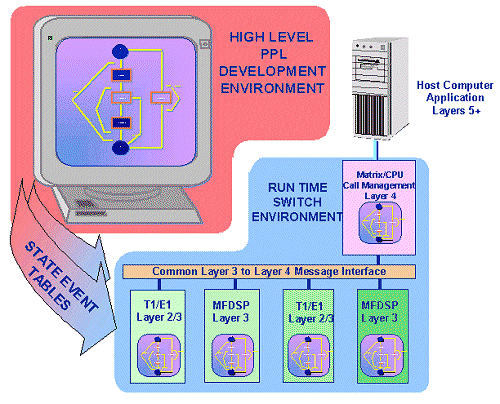
Figure 4.3-1. PPL technology is employed throughout the EXS Software environment, to provide the greatest levels of programmability possible.
4.4 EXS Software
The diagram below shows the software modules and layered functionality of EXS Software. Programmability has been built into each module and is accessible from a common set of development tools. Depending on the functionality required, and upon the level of existing service and management logic, service implementers can work at multiple levels. Services can be quickly created and integrated into any network or application, simply by customizing functionality at the right level(s): network signaling, call control, service logic, and operational support interfaces to network management, billing, subscriber management, and related intelligent services. Each EXS Software level is summarized below.
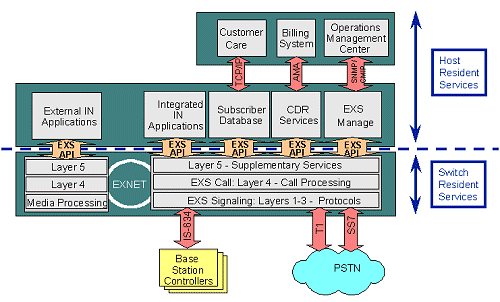
Figure 4.4-1. A distributed software environment provides greater flexibility and programmability.
Return to contents....
4.4.2 EXS Signaling
Standard signaling protocols have been captured within the programmable components of EXS Signaling. Using a high-level graphical user interface (GUI) programming tool and environment, script changes altering the flow of the signaling protocol and event parameters can be made to implement new signaling variants required for deployment anywhere in the world. At this layer, individual scripts unique to signaling protocol (including R2, ISDN, and SS7) or functionality required (such as tone generation or voice announcement) are downloaded in real-time to the EXS hardware component designated.
Since signaling engines are distinct from network connections, a number of different signaling protocols can be "distributed" and mapped to EXS hardware an any point in time. Signaling protocols are abstracted in a common Q.931-like interface to the next software layer, EXS Call Control (described below), so that call management within the EXS system can be implemented with one simple and common programming interface.
Using EXS Signaling software, new protocol variances can be implemented much faster than with traditional switches, and without having to ask the supplier to implement the needed change. In addition, this functionality provides built-in protocol conversion capabilities which can be implemented in a stand-alone mode without a host computer, greatly simplifying some applications and freeing host-processing capacity for pure service logic.
4.4.3 EXS Call Control
Connection control and routing management is provided by EXS Call Control. This layer is oriented toward establishing a call route within the EXS for each DS0, based upon a number of call control parameters (user-defined routing and translation tables, and resource group tables).
Unique and programmable call models can be quickly implemented with different combinations of call routes and control parameters. In fact, PBX-like features (such as one- and two-way connections, call parking, call hunting, etc.) can be built into the call model and be automatically executed. For efficiency and reliability, the entire call model can be implemented in a very modular manner and downloaded to distributed EXS Matrix/CPUs.
Messaging between distributed EXS switching modules keeps track of physical switch resources, and interacts with EXS Call Control software logic. EXS Call Control organizes physical resources within the EXS system into logical resource groups. Resources are mapped onto the physical connections and resources, and managed as a logical entity. This provides better performance, more flexibility, and reliability for services.
One EXS Call Control module can automatically "speak" to another, in order to provide automatic processing of totally unique call models which are distributed among the EXS switching modules. In this way, entirely new services can be implemented and integrated with legacy services without re-programming. Many basic call models can be completely, or partially, pushed-down onto the EXS platform in order to provide better performance and greater reliability. Should the EXS lose its host computer link, many basic switch services can continue running until the link has been re-established.
EXS Call Control contains a programmable component which can deliver call detail record information on for each connection in the EXS system in a variety of programmable formats. Information about each connection is captured according to parameter settings, and can be forwarded to the Call Detail Record services available.
EXS Call Control supports a multi-host environment which allows multiple services to simultaneously execute within the EXS platform. EXS Manage (discussed below), or third-party management functions, can configure EXS resources for multiple services, and EXS Call Control dynamically routes API messages and events to different host applications based upon a number of different criteria (call control, time-of-day, host link failures, etc.). Using the same EXS Tool, call control for individual services can be quickly modified and integrated into an overall service logic. If industry-standard call control models (such as TAPI, CSTA, or VERSIT), or totally application-specific call models need to be implemented, the application developer can produce his own programmable switch API within the EXS Call Control module.
Return to contents....
4.4.4 EXS Resource
A special implementation of EXS Call Control is implemented on the EXNET Connect card, and is called EXS Resource. EXS Resource establishes a unique call control model and interface to appropriate media resource APIs. Individual EXS and media functions can be closely mapped onto each other to accommodate centralized, distributed, or a mix of application control. The call model can also provide automatic call hand-off between different services and different EXS modules, based upon a number of parameters (call control, time-of-day, failed links, etc.) without host application involvement. In this way, media resources in multiple EXS media modules can be managed as one resource group, and should one of the media modules fail, call traffic can automatically be diverted to another available module. This is another example of how EXS' distributed architecture improves performance and reliability in many different scenarios.
4.4.5 EXS Manage
Once services are implemented, it is very important for a carrier to easily configure and keep services running; typically this is referred to as Operations, Administration, Maintenance and Provisioning (OAM&P). Excel has again used a programmable approach to provide EXS Manage for this purpose. EXS Manage interfaces with all layers of EXS Software: Signaling, Call Control, Resource, and Services to provide maximum flexibility and functionality in managing the EXS system. EXS Manage:
- Logs and reports system status, faults, alarms, and resource utilization;
- Maximizes uptime and reliability with automatic redundancy management and switch-over functions;
- Provides dynamic configuration and programmable reconfiguration based upon authorized operator input or operational conditions of the system (such as congestion or fault conditions);
- Provides an easy-to-use graphical operator interface;
- Provides a programmable interface to network management standards such as SNMP, CMIP, or TMN;
- Can be hosted on redundant and fault-tolerant PC based host computers embedded within the EXS configuration for maximum reliability in minimum floor-space; and,
- Provides rapid support of all EXS hardware and software capabilities.
Most EXS Manage functions are automatic, with manual over-rides, in order to minimize operator/craft-person involvement without sacrificing flexibility. EXS Manage automatically downloads EXS software, validates the hardware configuration, and provisions it against one of a number of programmable configuration models (templates). EXS Manage utilizes the programmable interfaces included throughout ONE Architecture, allowing its management capabilities to be extended to hardware, software, and services integrated within the platform.
4.4.6 EXS Services
Supplementary switching services (such as three-way calling, caller identification, call barring, do-not-disturb, wake-up calls, etc.) commonly implemented within telephone carriers end office infrastructure can be implemented within the EXS Services module. Just as lower-level EXS software modules build upon each other, and share the same common programmable technology and EXS Tools, EXS Services associates the call models, routes, and resource grouping to build complex, yet programmable supplementary services. Just as standard protocols and call models provide the programming basis within lower levels of EXS software, EXS Services provides a standard set of supplementary services which can be modified to fit the operator's special requirements. The time and cost needed to respond to new subscriber requirements by rapidly changing existing services, or by implementing completely new ones, is dramatically reduced.
Since many different services must be implemented at this level, EXS Services provides programmable interfaces to integrate a variety of third-party services. Included are interfaces to IN services, subscriber management databases, billing, and network management systems. This permits an emerging carrier to build a complete infrastructure by integrating best-of-breed service components into ONE Architecture cost-effectively and quickly. At the same time, an incumbent operator, that has already made an investment in network infrastructure and operations support systems, has the flexibility to integrate ONE Architecture into their existing network.
Return to contents....
4.5 EXS Hardware
At the foundation of ONE Architecture is the Expandable Switching System, EXStm.
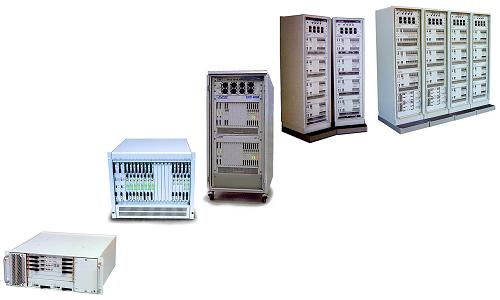
EXS combines one or more switching shelves into an integrated switching fabric that economically scales from 100 to 30,720 ports. The midplane of each shelf is extended into a shared fiber optic backbone, called EXNET, resulting in a non-blocking switching system whose resources are managed as one system. Logically, the EXNET backbone represents another layer in Excel's selective space switching hierarchy that enlarges the switching fabric to currently support over 30,000 ports. Integration of the EXNET backbone is achieved by equipping each switching module with an EXNET board-set. The EXNET card connects the midplane of each switching module into the EXNET fiber backbone, providing the same processing and switching capability as the central Matrix/CPU in each switching module. EXNET hardware provides the capability to switch up to 2,048 ports from each module onto the EXNET switching fabric. Channels from the EXNET backbone are selectively switched into each module as needed.
Media resources can also be integrated into the switching environment, via the EXNET Connect card. EXNET Connect allows service resources such as interactive voice response, voice recognition, voice mail, and voice over the Internet to be integrated with the switching fabric. Operating as another module in the EXS architecture, EXNET Connect is installed in a PC Chassis, connecting to industry-standard bus architectures such as ECTF, MVIP and SCBus to support media, and connecting directly onto the EXNET system backbone, making media resources directly accessible to every port on the EXS.
Altogether, the EXS provides an integrated switch and media system supporting over 30,000 non-blocking ports in a truly open and fully programmable environment.

Figure 4.5-1. The Distributed EXS Architecture enables the integration of network routing, multiple enhanced services and multi-media processing.
4.5.1 Open Architecture
The hallmark of the EXS family is its open architecture, which is based on three design considerations:
Open Connectivity enables developers and service providers to connect unrelated resources into a single logical system. With open connectivity, external voice resources such as interactive voice response, voice recognition, and voice over Internet devices can be integrated into the switch environment. Open connectivity also applies to the system's ability to adapt to worldwide network protocols and standards.
Open Design means the ability to operate with any host system, application language or operating system. It also means the ability to write applications independently of the network protocol, and to receive switch information in a consistent and unified format. Excel's Application Programming Interface (API) defines a rich set of standard messages that establish communications between the host system and the switch.
Open Technology employs a modular approach to enable the use and reuse of technology where it makes sense, and to upgrade to new technologies without redesign. Daughter card processor implementations permit new chip technologies to be introduced with out re-engineering the underlying board; and daughter cards can be used for multiple boards. This minimizes design costs, and preserves the investment in technology.
Return to contents....
4.5.3 Configurable and Scalable
The EXS supports from 100 to over 30,000 ports in a single, non-blocked switch. This means that service providers can configure the system they need to support today's services, and the system can be expanded to support new features, new services, new networks, geographic expansion or simple growth in the subscriber population without losing investment in hardware and without interrupting service.
In addition to its scalability, the EXS family is highly configurable. EXS systems can be expanded to increase switching capacity, add new services or connect voice resources. Each shelf is designed with an open slot architecture, enabling any combination of intelligent line cards, common channel signaling, digital signal processing and other resources up to the maximum for the chassis. This means that systems can be configured to meet the specific requirements of the service provider's application, and can be changed to meet new market needs.
With a distributed software architecture, intelligence is distributed to each card. Common channel signaling and DSP cards support a separate timeslot interchange, freeing up Matrix CPU timeslots for greater capacity and enhancing performance. Since they are not physically connected to the network line cards, provisioning flexibility is assured.
4.5.4 High Performance
The EXS uses a microprocessor technology to distribute processing across every resource in the system. A distributed processing architecture enables each intelligent card to share in the workload, off-loading matrix CPU processing, eliminating overhead on the matrix ports and substantially increasing overall throughput. This is demonstrated in a benchmark conducted by excel, using ISDN Feature Group D call model, which illustrates the capacity to support well over 100,000 busy hour call completions (BHCC) on a single EXS 2000 shelf, and over 1.2M BHCC on a 16,000 port EXS system.
4.5.5 High Reliability
The EXS family is built for central office deployment, and as such, reliability is a key requirement for these environments. The EXS internal bus is redundant by design, and the system backbone can be configured for redundancy. Similarly, power supplies and fan trays provide redundancy and backup. All resource cards, as well as the host interconnection, can be configured for redundancy/ Even line cards can be configured with "N+1" redundancy, a cost-effective approach to reliability with the network. All cards are hot-insertable and removable, so that the system can undergo maintenance or expansion without interruption to service.
Return to contents....
5.0 Summary and Conclusions
With ONE Architecture, carriers are no longer limited by the complexity of traditional, hierarchical switching networks. They are no longer dependent upon switch suppliers for new services, new network connectivity, or new media support. They are not required to invest in new platforms each time they expand their networks. And they are no longer limited to offering the very same services that their competition can offer.
With ONE Architecture, carriers are empowered to support integrated network routing services, a multiplicity of enhanced services, and powerful multi-media offerings on a single, scalable, distributed and open platform. These capabilities offer unprecedented opportunities to prosper in the dynamic telecommunications market, including the ability to:
Be first to market with new services;
Compete and win on price and service offerings;
Gain market share via expanded services and broader coverage;
Acquire and retain customer loyalty;
Offer the best price while getting the best return on investment;
Future-proof service platforms to support change and growth; and,
Safeguard and leverage service platform investments.
ONE Architecture empowers the kind of creativity in telecom that carriers must apply in order to stay competitive in a constantly changing and challenging marketplace. ONE Architecture enables carriers to become a market leader and remain a leader.